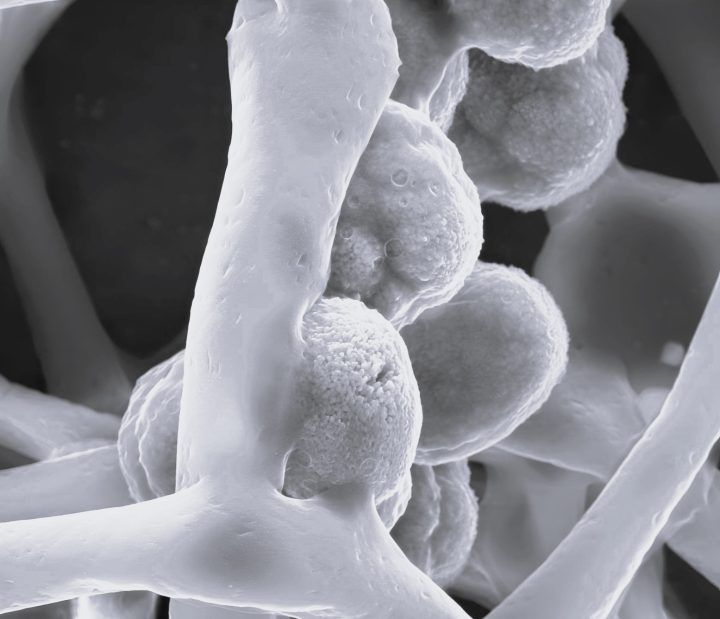
scanning electron micrograph of nanofibers made by electrospinning

Current challenges of electrospinning—and practical solutions

From lab art to manufacturing science

Current challenges of electrospinning

Electrospinning is now well-established at the laboratory scale, yet the transition to medical-grade, industrial production exposes persistent technical barriers. Four major hurdles are described here along with a pathway to solve them:

  1. Precise fiber morphology control
  2. Formulation of complex regenerative biocomposites
  3. Manufacture of thick, highly porous three-dimensional (3-D) constructs, and
  4. High-throughput/quality-assured scale-up—are discussed below.
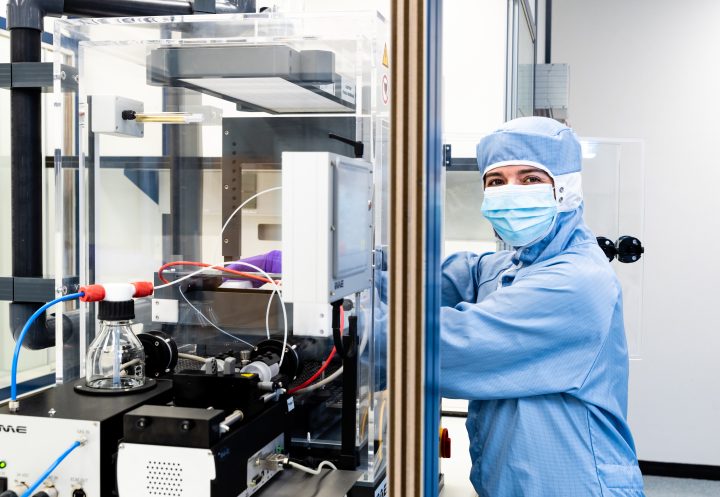
Scientist working in a lab.
Medical grade precision

1. Uniform and Consistent Fiber Morphology

Controlling fiber diameter, alignment, and pore structure is critical to an electrospun material’s end-function, particularly in medical applications. The performance of an electrospun device (be it a scaffold or filter) depends heavily on the fibers’ physical characteristics. Small variations in fiber diameter or morphology can lead to big differences in mechanical strength, porosity, and biological response. Yet achieving uniform fiber diameter and alignment at scale is non-trivial.

Many factors – polymer solution concentration, voltage stability, ambient humidity, etc. – influence fiber formation, and slight drifts can introduce variability. For instance, as a multi-hour electrospinning run progresses, solvent evaporation might cool the spinneret or change solution viscosity, causing fiber diameter to shift from the beginning to the end of a batch. Maintaining batch-to-batch consistency is thus a challenge; one batch might produce 1.0 μm fibers while the next is 1.5 μm on average, which in a medical product could be the difference between success and failure.

Environmental control is critical: fluctuations in humidity or temperature can alter fiber morphology or cause defects like beads. In fact, industrial trials have noted that without strict climate control, daily weather changes led to inconsistent fiber mats. Another aspect is fiber alignment and patterning. Some applications need aligned fibers (e.g. nerve or muscle scaffolds), others need specific 3D architectures (like a gradient of fiber density).

Creating these advanced architectures reliably is difficult – it often requires specialized collectors or methods like rotating mandrels, and even then, ensuring every section of a large mat has the same alignment is a challenge. The pore size resulting from fiber packing is linked to fiber diameter and how fibers lay down; if the process can’t tightly control these, the pore size distribution may vary, affecting cell infiltration or filtration efficiency. For medical scaffolds, one often needs a fine balance: small pores to encourage cell attachment, but large enough pores for cell migration. Electrospinning’s layer-by-layer deposition can inherently lead to small pores, so achieving larger, well-distributed pores (via techniques like fiber cross-linking or sacrificial fiber removal) adds complexity.

In summary, the challenge is to reproducibly produce fibers of a specified diameter (say 750 ± 50 nm) and micro-architecture under manufacturing conditions. This requires robust control strategies to tighten tolerances on all influencing parameters.

Advanced formulations

2. Regenerative Biocomposites and Difficult Formulations

Spinning complex mixtures for bioactive scaffolds remains a persistent challenge in the field of electrospinning. Many cutting-edge electrospun products involve composite fibers – for example, combining a synthetic polymer with a natural polymer, or embedding high loadings of bioactive particles (like hydroxyapatite for bone or drug nanoparticles for delivery). These complex recipes improve functionality but are challenging to spin.

Natural biopolymers (collagen, fibrin, etc.) often have limited solubility or can degrade in harsh solvents, making them hard to directly electrospin into good fibers. Researchers thus resort to blending them with a carrier polymer or using co-axial spinning, but even then, solvent compatibility is a big issue. Finding a mutual solvent for two polymers, or one that can suspend a large amount of particles, without either clogging the nozzle or causing jets to break, is non-trivial. For instance, to electrospin a collagen/PCL blend scaffold, one may need a fluorinated solvent cocktail at specific ratios – slight deviations cause phase separation or beaded fibers. Moreover, some bio-additives (growth factors, enzymes, live cells) are sensitive to organic solvents and high voltage.

Emulsion electrospinning can encapsulate proteins in protective droplets during spinning, but the process must be finely tuned to maintain their activity. High loading of biological cues is another challenge: to have a therapeutic effect, one might want a high concentration of, say, an antibiotic or growth factor in the fibers, but too high a loading can destabilize the jet or result in inhomogeneous distribution. High particle loading (like 50% by weight hydroxyapatite) tends to increase viscosity and surface tension, often making the solution unspinnable or leading to frequent needle clogging. Additionally, volatile solvents often used for fast fiber solidification (e.g. dichloromethane, acetone) can cause rapid polymer precipitation – with heavy additive loads this can clog spinnerets quickly or produce uneven fiber morphologies.

In summary, creating regenerative biocomposites – fibers that carry the biological “payload” needed for tissue regrowth – demands overcoming significant formulation issues. We need advances in solvent systems (such as benign, water-based spinning for some materials) and spinning technology (like advanced mixing or multi-channel jets) to stably produce these complex fiber systems. The unmet need is to electrospin high concentrations of bioactive agents or difficult polymers without sacrificing process stability or fiber quality.

Relevant dimensions for medical devices

3. Large-Thickness Constructs

Building thick 3D scaffolds (>2–3 mm) without compromising porosity is critical for replacing clinically relevant tissue defects, yet scalable solutions to this challenge are scarce.

Many tissue engineering applications (e.g. for muscle, thick dermal wounds, meniscus, or load-bearing scaffolds) require thick electrospun constructs – often several millimeters thick. Electrospinning traditionally produces thin sheets or mats; making them thicker typically involves long spin times or layer stacking. However, as thickness increases, several problems arise: uniformity through the thickness is hard to maintain (the bottom layers may compress under the weight of new fibers, changing porosity), and residual charge accumulation can cause later fibers to repel or lead to structural instabilities.

Indeed, as an electrospun mat builds up, the deposited fibers carry residual electrostatic charge that can start repelling incoming fibers, effectively creating an upper limit to thickness before fibers start flying off target. Additionally, obtaining high porosity in thick scaffolds is challenging – often thick electrospun blocks become very dense in their interior because fibers fill in voids as they settle in layers, leading to small pores that cells cannot penetrate. The inherent layer-by-layer deposition means fiber spacing in the vertical direction is constrained. Achieving pore sizes of hundreds of microns throughout a 5 mm thick scaffold (ideal for cell migration and nutrient flow in bulk tissue) is not straightforward. Techniques like periodically disrupting the fiber deposition (to introduce more space) or using sacrificial fibers that can be dissolved out have been attempted to increase pore size in thick mats.

Process stability over long durations (for thick builds) is another issue: spinning for many hours can lead to nozzle clogging (especially with volatile solvents that dry at the tip) and polymer solution changes (e.g. evaporation changing concentration). Maintaining consistent fiber output over, say, an 8-hour continuous run to form a 5 mm scaffold is a non-trivial challenge in current setups.

In summary, while electrospinning excels at thin membranes, the field must innovate to create thick, fluffy, highly porous 3D scaffolds with controlled architecture. This likely involves not only process tweaks but also apparatus changes (e.g. dynamic collectors, charge neutralization methods, or combining electrospinning with 3D printing). Overcoming this challenge is crucial for applications like orthopedic and sports medicine implants where a certain minimum thickness is needed for mechanical integrity and to fill tissue defects.

researcher using a VIVOLTA EC-CLI electrospinning equipment
Complex shapes for diverse applications

4. High-Volume Production of 2D and 3D Forms

Scaling throughput while maintaining quality of complex 2D and 3D forms remains the Holy Grail for medical electrospinning.

Traditional electrospinning (single-needle lab setups) yields only a few grams of material per hour at best – far too slow for mass production of large or numerous medical devices. To meet commercial needs (for example, millions of wound dressing units per year, or kilometers of nanofiber web for filtration), scale-up is essential. However, scaling electrospinning is difficult due to the delicate balance of forces in each spinning jet.

Approaches to increase throughput include using multiple needles in parallel, needleless spinning (using a rotating charged drum or wire to launch multiple jets), or increasing solution concentration to eject more mass per jet all pose significant challenges. Each approach has issues: multi-needle arrays can suffer from jet interference (electric fields from adjacent needles perturb each other) and a higher incidence of clogging; needleless systems produce many jets but often with less control (and risk solvent vapor buildup). Ensuring uniform fiber quality across all jets is a significant challenge – jets at the edges of an array may behave differently than those at the center due to field non-uniformity, leading to fiber diameter differences. Additionally, with many jets, solvent evaporation in the chamber increases, potentially altering humidity and local solvent concentration, which can affect fiber formation.

Another challenging aspect of scale-up is speed and collection: high-throughput spinning might involve rapidly moving collectors (conveyor belts, rotating mandrels) to gather fibers continuously rather than batch sheet collection. Synchronizing the fiber deposition with moving targets while keeping fiber layering consistent requires precision engineering.

Quality control (QC) at high volume is also a challenge – when producing large quantities, one must ensure each section of the product meets specifications (thickness, fiber diameter distribution, etc.). Traditional off-line QC (like cutting samples and imaging under SEM) is too slow for million-unit production. Thus, integrating real-time sensors (for thickness, basis weight, potentially even fiber diameter via optical methods) into the production line is an emerging need. The industry has identified three critical hurdles for scale-up: Consistency, Quality Control, and Scalability of machinery. Consistency refers to maintaining the same fiber/output despite environmental or feed fluctuations; QC refers to monitoring and controlling properties in-line; and scalability of machinery refers to designing equipment (like multi-nozzle or wide-area spinning systems) that can run continuously without fouling or variability.

For context, a single-needle can produce on the order of 0.1–1 gram/hour, whereas an industrial goal might be >100 grams/hour (or even kilogram/hour for low-cost applications) – a 100-1000x increase. Achieving that without sacrificing fiber quality is non-trivial. Any instability that might be negligible in small scale (a slight fluctuation every few minutes) becomes magnified in large-scale continuous runs.

This is why historically few electrospun products made it to market – the lab success didn’t easily translate to factory success. Therefore, innovation in equipment design (e.g. multi-needle setups with isolated electric fields, or novel collectors allowing 3D fiber deposition, or even alternate spinning techniques like centrifugal electrospinning) is vital. The goal is to reach high throughput while preserving the nanometer precision that electrospinning is valued for. In short, to move electrospinning from an art to a robust manufacturing science, these scale-related challenges must be addressed through engineering solutions and rigorous process controls.

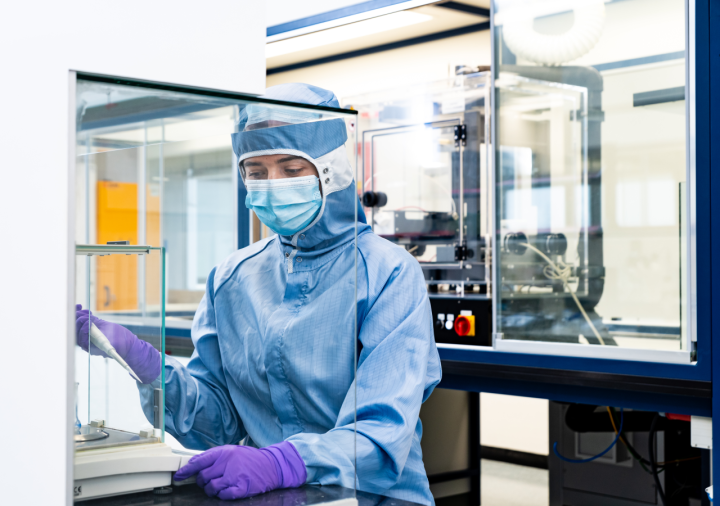
Working in a lab.
Outlook

Transforming challenges into solutions

Progress over the past five years shows that none of the challenges are insurmountable, but solving one often sharpens another. For example, moving to benign solvents eases toxicology concerns yet narrows the processing window and slows evaporation and lowers throughput. The field is moving toward integrated systems that couple environmental control, multiphysics modelling, inline sensors and advanced collector designs. Translational success will likely depend on marrying these engineering solutions with regulatory-ready, green-solvent chemistries—turning electrospinning from an art into a fully digital-controlled manufacturing science.

For more information on how VIVOLTA is solving these persistent challenges with its advanced electrospinning technology, read further!

electrospinning machines & equipment with researcher showing versatility in nanofiber applications
Read more

Curious to learn more?

scanning electron micrograph of nanofibers made by electrospinning

What is electrospinning?

Understand the core process, key parameters, and material science foundational to electrospinning

microscope image of nanofibers made by electrospinning

Key medical applications

Learn about electrospinning’s use in cardiovascular, orthopedics, wound healing, and many more medical device segments with this in-depth review of the most important peer-reviewed literature.

VIVOLTA electrospinning technology

Discover our integrated electrospinning technology for process control and repeatability and how we’re solving electrospinning’s biggest challenges in meaningful ways.

microscope image of nanofibers made by electrospinning

Scalable electrospinning unlocked

Explore the world’s first fully automated, high-throughput medical electrospinning production platform – the MediSpin™ system.

FAQ

Can I just “turn up” voltage to get more output?

Not reliably—other parameters and charge effects must move in concert to keep quality stable.

Why do samples look different week to week?

Climate, solution age, and charge buildup are common culprits; stable environment and procedures help.

Is multi‑needle always better?

 Only if coordinated with motion, charge control, and in‑line checks.

Learn more

Ready to get started?

VIVOLTA's full suite of solutions

Learn why our client’s choose us as their trusted contract development and manufacturing partner for next-generation electrospun medical devices.

white paper - electrospinning current challenges and solutions

Read the white paper

Ready to dive deep into the world of electrospinning to understand its key medical applications, challenges, and VIVOLTA’s scalable manufacturing solutions? Download the PDF today.

PDF Donwload

"*" indicates required fields

You're almost there

Fill in the following to receive the PDF in your inbox:

Name*

Request a brochure - CDMO services

This field is for validation purposes and should be left unchanged.

About You

Your Name(Required)
Your Address
Your Email Address(Required)
A valid email address is required to deliver a brochure.
How did you find us?(Required)