EC-CLI Applications
One Electrospinning Machine for Every Nanofiber Application
Filtration, energy storage, smart textiles, agriculture — each field asks something different of an electrospun fiber. This page maps the persistent process challenges in each application to the exact EC-CLI capabilities and add-on modules that solve them, so your research reaches a reproducible result faster.
100+
EC-CLI systems installed worldwide
1000+
Publications citing our platform
±0.5°C
Climate control that keeps fiber diameter reproducible
10+
Plug-and-play modules to configure per application
On most electrospinning machines it does not, because temperature and humidity move the process while no one is watching. The EC-CLI electrospinning machine was built to remove that variability: independent closed-loop control of temperature (20–45 °C, ±0.5 °C) and humidity (10–80% RH, ±2%) is standard on every system — not an expensive add-on.
A library of plug-and-play add-on modules then lets you shape fibers, scale throughput, and add in-line quality control without reconfiguring the base machine. Below, each application is broken down the same way: the design goals and process challenges that define it, and the specific EC-CLI configuration that meets them.
New to the technique? For the physics of the process itself — the Taylor cone, jet whipping, and how each parameter behaves — start with What Is Electrospinning? Developing a clinical device? See Medical Applications under our CDMO services.
Four levers decide whether an application succeeds.
Whatever the field, the same four variables determine whether an electrospun material performs — and whether it performs again next week.
Reproducibility
Fiber diameter and morphology must hold constant across runs, operators, and seasons.
Architecture
Flat, tubular, aligned, porous, or core–shell — the geometry the application demands.
Throughput
Enough usable material area to move from a coupon to a real device or study.
Quality Control
In-line measurement so deviations are caught during the build, not after it.
Air & water filtration: capture the fines without paying in pressure drop
Electrospun media is one of the most mature industrial uses of the technology. Sub-micron diameters and residual charge capture the ultrafine particles conventional filters miss, fibers below ~500 nm markedly raise efficiency by multiplying interception points, and PAN, PVDF, and biopolymer webs reach high efficiency at low pressure drop.
The design goal is a narrow, repeatable fiber-diameter distribution and controlled pore structure — efficiency and pressure drop both live or die by it. The persistent challenge: that distribution is exquisitely sensitive to ambient humidity, so performance drifts batch to batch on uncontrolled machines, and volatile solvent systems such as PVDF in DMF clog the nozzle before a usable area is built.
How the EC-CLI solves it: integrated climate control locks the humidity that governs fiber diameter and surface morphology, so the media you validate is the media you can reproduce.
Recommended equipment add-on configuration for filtration work:
| Add-on module | Key features |
|---|---|
| EM-RDC Rotating Drum Collector | Large uniform media, up to 200 × 300 mm |
| EM-MN4 Multi-nozzle | Up to 4× throughput toward usable media area |
| EM-GSM Gas Shield Module | Keeps volatile solvent systems spinning without clogging |
| EM-TMM Thickness Measurement | In-line areal build-up, 5σ < 50 µm, holds pressure drop consistent |
| EM-ASM Anti-statics Module | Neutralises the charge build-up that caps depth-filter thickness |

Batteries, fuel cells & supercapacitors: uniformity is the performance spec
In energy devices, electrospun mats become separators and electrodes. Nanofibrous Li-ion separators offer large surface area and uniform pore structure that speed Li⁺ transport and absorb electrode volume change during cycling; carbon-nanofiber gas-diffusion layers raise fuel-cell power density, and these mats already manufacture at tens of thousands of m²/yr.
The design goal is uniform thickness and pore structure over large areas, with alignment where directional transport helps. The persistent challenge: separator thickness variance quietly degrades cycling consistency, precursor-mat reproducibility before carbonisation is hard to guarantee run to run — and then it all has to scale.
How the EC-CLI solves it: dual-polarity voltage with built-in ramping stabilises the thicker mats robust separators need, while climate control keeps the precursor mat identical every time.
Recommended equipment add-on configuration for energy storage applications:
| Add-on module | Key features |
|---|---|
| EM-RDC Rotating Drum Collector | Large, orientation-controlled membranes |
| EM-TMM Thickness Measurement | Real-time layer build-up keeps separator and GDL thickness in spec |
| EP-HRU Dual Syringe Pump | Synchronous flow control for multi-channel setups |
| EM-MN4 + EM- TNS Multi-nozzle & translation stage | Multiplies output toward pilot-scale |
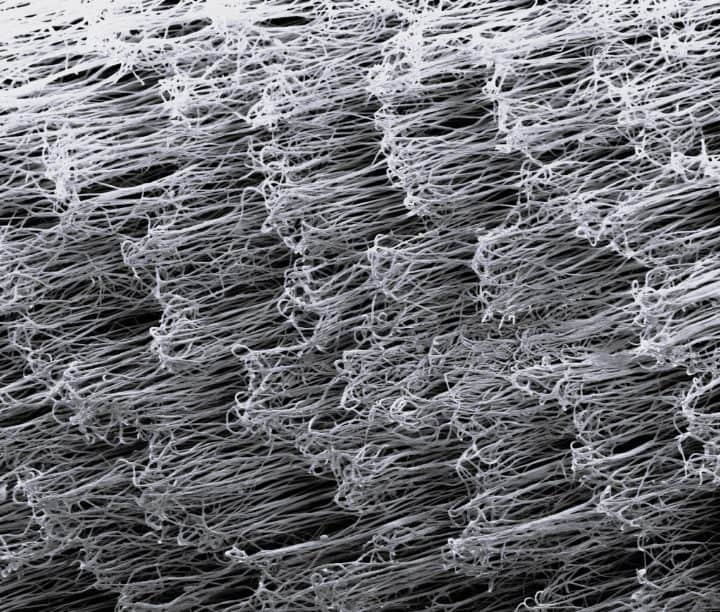
Functional fabrics that sense, conduct, and breathe
Because electrospun fibers can be spun extremely fine and loaded with functional materials, they suit lightweight fabrics that sense, conduct, or convert stimuli into signal. Silver-nanowire yarns add strength and conductivity for wearable circuitry; polyimide nanofiber membranes deliver breathability with durable waterproofing for athletic outerwear.
The design goal is fiber alignment and continuity for conductive paths, plus repeatable porosity that balances breathability against barrier performance. The persistent challenge: aligned, continuous conductive fibers are hard to produce over fabric-relevant areas, and multi-material fibers demand independent control of two feeds at once.
How the EC-CLI solves it: integrated climate control holds the porosity that decides the breathability-versus-waterproofing trade-off, membrane after membrane.
Recommended equipment add-on configuration for textile applications:
| Add-on module | Key features |
|---|---|
| EM-RDC Rotating Drum Collector | Up to 2,500 rpm for aligned fibers and yarns |
| EM-CAX Coaxial Nozzle | Sheath-core fibers that encapsulate conductive or active payloads |
| 2 x EP-HRU Dual Syringe Pumps | Independent flow control of core and shell feeds |
| EM-MN4 Multi-nozzle | Fabric-relevant area from four parallel nozzles |

Delivering agrochemicals on a schedule the seed sets
Biodegradable nanofiber seed coatings can release nutrients or crop-protection agents slowly as a seed germinates, improving early growth with less total chemical input. Pheromone-loaded fibers form an invisible barrier that disrupts insect mating cycles as an eco-friendlier pest-control strategy.
The design goal is a tunable release profile and biodegradation rate, produced with benign solvents. The persistent challenge: release kinetics depend on tightly controlled fiber diameter, porosity, and core–shell encapsulation — and green solvent systems still have to spin stably at a scale that makes field trials affordable.
How the EC-CLI solves it: climate control holds the diameter and porosity that set the release rate, run after run.
Recommended equipment add-on configuration for agriculture applications:
| Add-on module | Key features |
|---|---|
| EM-LTE Low-temperature Collector | High-loading carriers up to 99.8% porosity |
| EM-CAX Coaxial Nozzle | Encapsulates actives in a core–shell fiber for a release profile you tune |
| EM-GSM Gas Shield Module | Keeps water-, ethanol- and other benign solvent systems spinning cleanly |
| EM-MN4 Multi-nozzle | Field-trial quantities from a single session |
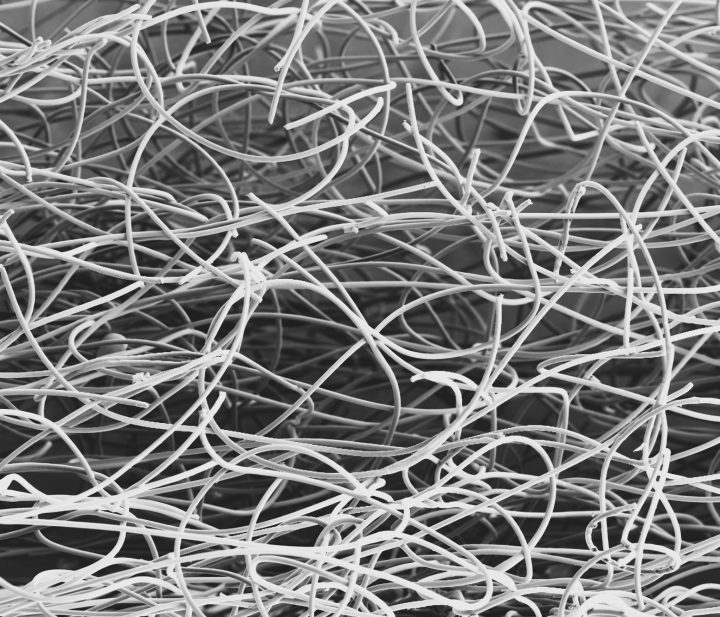
The same platform reaches applications not yet imagined
Working in a field not listed here? Talk to an application engineer — chances are we have configured the EC-CLI for something close.
Advanced Materials
Environmental-remediation membranes and functional composites.
Cosmetics
Nanofiber carriers for controlled-release actives and masks.
Food Packaging
High-barrier and active-packaging membrane layers.
Semiconductors
Templating and sacrificial nanofiber structures for R&D.
Whatever the application, the process challenges rhyme — and each maps to a specific EC-CLI capability
Use this as a shortcut: find the goal that defines your work, and the module that delivers it.
EC-CLI CLIMATE CONTROL
Constant fiber diameter
Ambient temperature and humidity move the process between runs. Closed-loop control (20–45 °C ±0.5, 10–80% RH ±2%) holds it — standard on every system.
EM-RDC
Large uniform membranes
Coverage and alignment fall off across area on a static plate. The rotating drum holds both, up to 200 × 300 mm.
EM-MN4 + EM-TNS
Higher throughput
A single nozzle is too slow for device- or pilot-scale area. Four parallel nozzles plus a second translation stage multiply output.
EM-CAX + 2× EP-HRU
Core-shell fiber
Functional core–shell fibers need two feeds under independent, precise flow control — a coaxial nozzle and two syringe pumps.
EM-LTE
Ultra-high porosity
Conventional collection cannot template large void fractions. Cryogenic ice-templating reaches up to 99.8% porosity.
EM-GSM
Volatile solvents
Premature evaporation clogs the nozzle and destabilizes the cone. A solvent-vapor shield keeps volatile systems spinning.
EM-ASM
Thick, defect-free mats
Residual charge repels incoming fibers and caps build height. Active ionization neutralizes it during long builds.
EM-TMM
In-line quality control
Offline metrology wastes material and finds problems too late. Real-time laser thickness holds 5σ < 50 µm.
When your application outgrows the lab, your process comes with it
The EC-CLI is the R&D backbone of VIVOLTA’s own contract manufacturing. Because the same team built both, a process developed on the EC-CLI can transfer and validate on the automated MediSpin™ platform in our ISO 13485-certified facility. Your parameters carry over.
STEP 1: Develop on the EC-CLI
Climate-controlled parameter development on your own machine, with specialist support where you need it.
STEP 2: Document the protocol
A repeatable, transferable protocol your team owns — the basis for any later transfer.
STEP 3: Transfer to MediSpin™
Validated production in our ISO 13485 facility when the application reaches clinical or commercial volume.
Built for professional grade research & development
In North America, EC-CLI systems support advanced nanofiber research at institutions including Harvard University, Draper Laboratories, and ISurTec. We ship, install, and support worldwide — including the US, Japan, and Australia.
2008
Founded as a TU Eindhoven spin-out
100+
Systems installed on six continents
7+
Patent families, including MediSpin™
ISO 13485
Certified engineering heritage

Tell us about your application
Our application engineers will recommend the right EC-CLI configuration and add-on modules for your field — or design a complete new setup. We ship and support worldwide.
Questions & answers
How is this Applications page different from the What Is Electrospinning explainer?
The What Is Electrospinning page explains the process and science — the Taylor cone, jet behavior, and how each parameter influences fiber formation. This page is commercial and application-specific: it maps the design goals and process challenges of each field to the exact EC-CLI machine capabilities and add-on modules that solve them, so you can specify the right system.
Can the EC-CLI scale from a research coupon to pilot quantities?
Throughput scales through equipment rather than a new machine: the EM-MN4 multi-nozzle multiplies deposition up to 4×, and adding an EM-TNS translation nozzle stage to an EM-RDC or EM-RTC collector runs a second nozzle simultaneously. For true clinical or commercial volume, processes developed on the EC-CLI transfer to VIVOLTA’s automated MediSpin™ platform in our ISO 13485 facility.
How does the EC-CLI keep results reproducible across seasons and operators?
Independent closed-loop control of temperature (20–45 °C, ±0.5 °C) and humidity (10–80% RH, ±2%) is standard on every EC-CLI, continuously verifying actual conditions against your setpoints even during multi-hour runs. Because relative humidity strongly governs fiber diameter and surface morphology, controlling it is what makes the media you validate the media you can reproduce — regardless of the ambient lab climate or the day.
What do I need for core–shell fibers for controlled release?
Core–shell (coaxial) fibers require the EM-CAX coaxial nozzle — 0.4 mm core, 1.2 mm shell, custom sizes on request — and typically two independent EP-HRU syringe pumps so the core and shell feeds are controlled separately. Pair the EM-CAX with the EM-GSM gas shield when the shell uses a volatile solvent, and the EM-LTE low-temperature collector when you also need very high porosity.
Can I produce battery separators or fuel-cell layers with consistent thickness?
Yes. The EM-TMM thickness measurement module monitors layer build-up in real time (variation typically 5σ < 50 µm) so separator and gas-diffusion-layer thickness stays within spec, while the EM-RDC gives large, orientation-controlled membranes and dual-polarity voltage stabilizes the thicker mats robust separators require. Integrated climate control keeps the precursor mat identical run to run before any carbonization step.
Which EC-CLI configuration is best for filtration research?
For air or liquid filtration media, start with the EC-CLI base machine for climate-controlled, reproducible fiber diameter, then add the EM-RDC rotating drum for large uniform membranes and the EM-MN4 multi-nozzle to reach usable media area. Add the EM-GSM gas shield if you spin volatile solvent systems such as PVDF in DMF, the EM-TMM for in-line areal-thickness QC, and the EM-ASM anti-statics module for thicker depth filters.